Tendon injuries are common in orthopedics and sports medicine, often leading to pain, impaired mobility, and long-term disability. For severe tendon rupture or large tendon defects, surgical reconstruction usually relies on autografts, allografts, or artificial substitutes. However, current strategies remain limited by donor-site morbidity, immune rejection, insufficient tissue integration, and poor long-term durability. Meanwhile, conventional regenerated silk fibroin hydrogels, despite their excellent biocompatibility and processability, are typically too weak to meet the mechanical demands of load-bearing tendon repair.
Recently, Prof. Wenwen Huang’s team, in collaboration with Prof. Weiliang Shen and Prof. Xiao Chen from Zhejiang University School of Medicine, published a research article entitled “Tough and hierarchically-structured silk hydrogel for artificial tendons” in Biomaterials. Inspired by the multiscale aligned architecture of native tendons, the study developed a water-based physical processing strategy combining directional freezing and hot-stretching to fabricate tough, hierarchically structured silk fibroin hydrogels, named DFHS hydrogels. At a high water content of approximately 70 wt%, the DFHS hydrogel achieved an ultimate tensile strength of 13.9 MPa and a fracture toughness of 45.5 kJ m⁻², with mechanical performance comparable to the human anterior cruciate ligament and excellent long-term structural stability.
In this strategy, directional freezing first induces anisotropic ice crystal growth to generate micrometer-scale aligned honeycomb-like pore walls within the regenerated silk hydrogel. Subsequent hot-stretching above the water-associated glass transition temperature promotes the reorientation of silk fibroin molecular chains and β-sheet nanocrystals. Through this synergistic “microscale channel alignment + nanoscale β-sheet orientation” mechanism, the DFHS hydrogel recapitulates the hierarchical anisotropy of native tendon tissue.
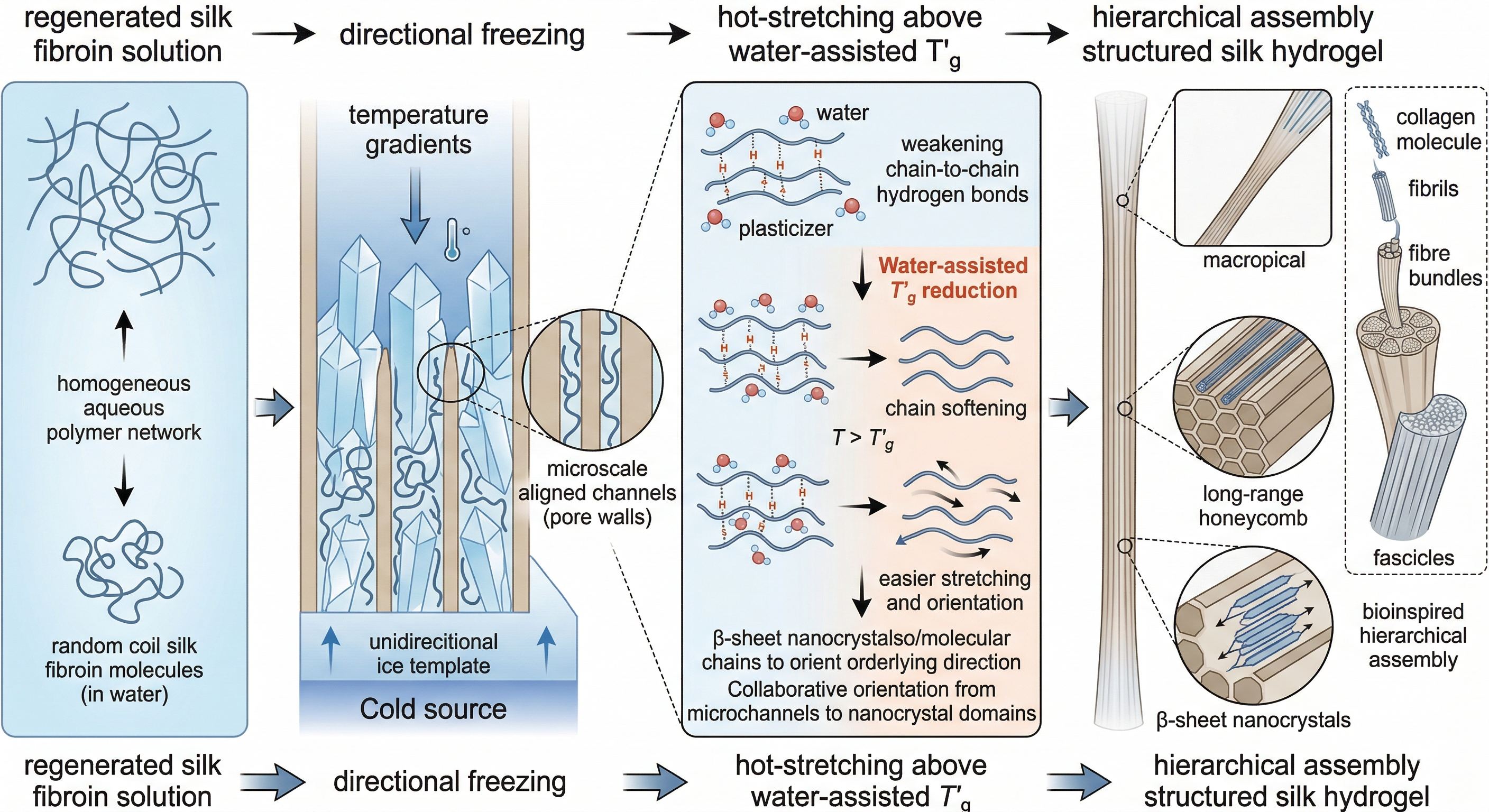
The optimized DF15H95S60 hydrogel, prepared with 15 wt% silk fibroin, hot-stretching at 95 °C, and a 60% stretching ratio, exhibited superior mechanical properties, including a tensile strength of 13.9 ± 2.1 MPa, a Young’s modulus of 16.3 ± 3.0 MPa, and a fracture toughness of 45.5 ± 7.5 kJ m⁻². Further analyses showed that the mechanical reinforcement was not simply caused by dehydration-induced densification, but arose from multiscale structural reorganization induced by directional freezing and hot-stretching.
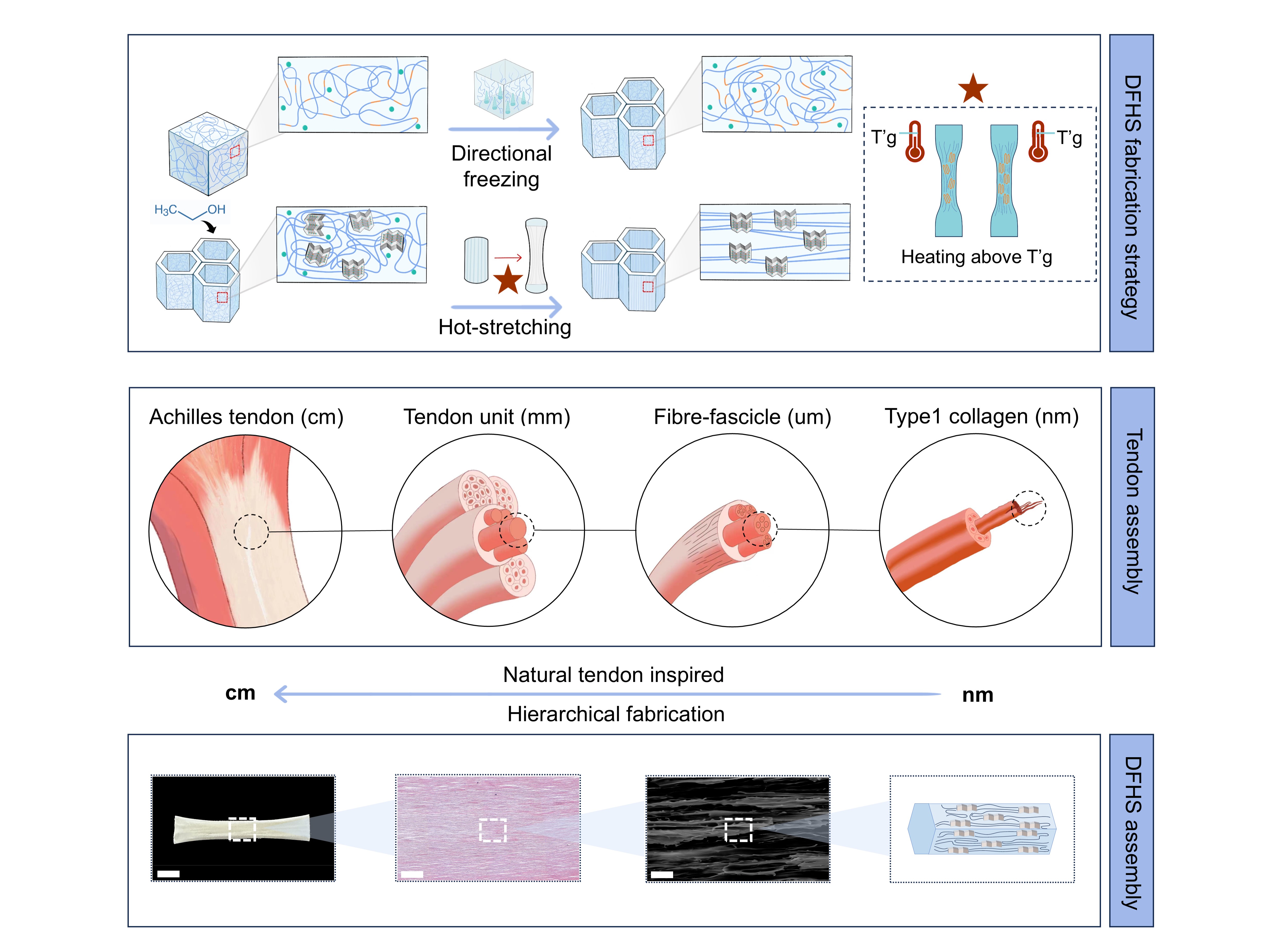
In biological evaluations, the DFHS hydrogel showed good cytocompatibility and pro-tenogenic potential. Its tendon-mimetic anisotropic microstructure guided cell alignment and activated signaling pathways related to extracellular matrix remodeling and tendon formation. In a rabbit Achilles tendon defect model, DFHS hydrogels maintained long-term structural and mechanical integrity, provided sustained mechanical support, and promoted the organized ingrowth and maturation of neo-tendon tissue. At 48 weeks after implantation, the regenerated tendon in the DFHS group displayed tissue morphology closer to that of native tendon.
Overall, this study presents a facile and biocompatible physical processing strategy for transforming regenerated silk fibroin hydrogels from mechanically weak soft materials into tough, tendon-mimetic artificial scaffolds. The work provides a promising silk-based platform for tendon repair and offers a generalizable design principle for toughening other semicrystalline polymer hydrogels.
Dr. Sicheng Zhou from Zhejiang University School of Medicine/Liangzhu Laboratory, Dr. Kexin Nie from the Zhejiang University–University of Edinburgh Institute, and Dr. Boxuan Wu are co-first authors of the paper. Congcong Qin, Jingyi Tian, Lele Li, Zhang Fan, Prof. Zi Yin, and Prof. Hongwei Ouyang made important contributions to this work. Prof. Xiao Chen, Prof. Weiliang Shen, and Prof. Wenwen Huang are the corresponding authors. This work was supported by the Key R&D Program of Zhejiang Province, the Huadong Medicine Joint Funds of the Zhejiang Provincial Natural Science Foundation of China, the National Natural Science Foundation of China, and the Zhejiang Lingyan R&D Project.
Original article: https://doi.org/10.1016/j.biomaterials.2026.124294