Professor Sue Welburn, Executive Dean at ZJE, takes inspiration from the class of 2026, who took centre stage at last night’s graduation celebration.
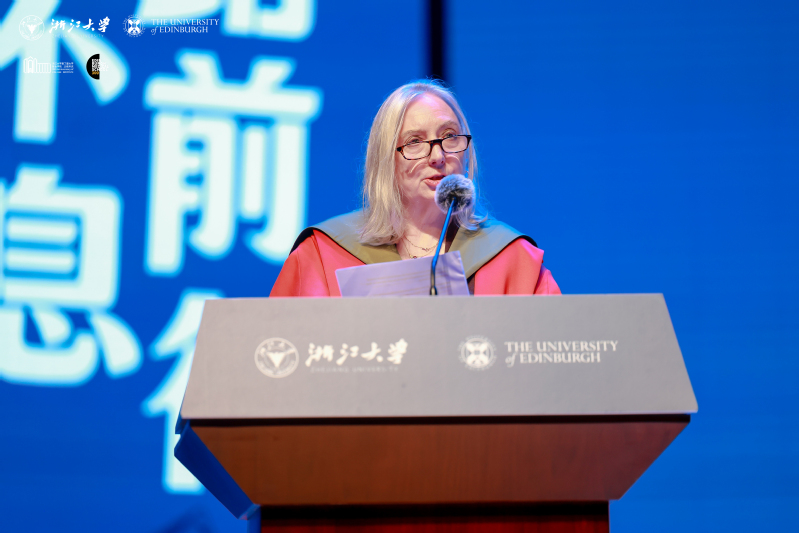
Prof Welburn addressing the audience at the graduation celebration.
When SHAO Qizhe took to the stage to address the parents, faculty and graduating students at the graduation celebration last night, he talked about a nine-year journey with ZJE. My colleagues and I have had the privilege of watching a shy young man grow into the fully fledged scientist he is today. His journey with ZJE culminated in him graduating with a PhD in Integrative Biomedical Sciences.
In the rehearsal for the graduation ceremony, he read his speech without looking up. Last night he looked at the audience and smiled confidently. We asked him how he had improved so much. He said that overnight he had practiced many times. This is typical of students’ attitude to being the best version of themselves and their willingness to put in the work to make sure this happens.
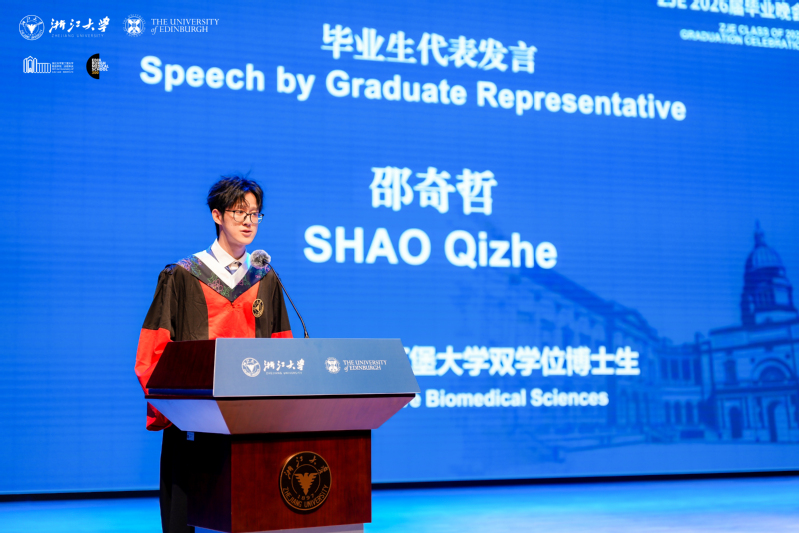
SHAO Qizhe showing the best version of himself.
A key feature of the graduation ceremony for me is hearing the students describe their growth and development. In his presentation, SHAO talked about his learning journey. He reminded us: that research is never a straight road. It is full of failed experiments, unexpected results, and long conversations that begin with “why is this not working?” But it is also full of moments of discovery: the first time a piece of data begins to make sense, the first time we feel that our work may contribute, even just a little, to human knowledge.
This theme of adding to knowledge and service was one that recurred through the evening. It was inspiring to hear from this young scientist who has been in step with us almost since our inception. What he described was the resilience that ZJE instils in them.
My address followed on from Professor Gu, representing the Zhejiang side of the partnership, and Professor Argyle, representing Edinburgh. The three of us reflected on what has been achieved in just 10 years. Central to this is giving our students the best that two world-class universities can offer. Edinburgh Medical School is 300 years old this year; Zhejiang University will be 130 next year. This means we built the Institute on solid foundations. The fact that Zhejiang University is one of two Chinese universities that recently ended Harvard’s ten-year reign at the top of the prestigious Nature Index academic rankings adds weight to this claim.
I may be biased, but the evidence I see is that the ZJE takes the best from both its parents and adds some magic of its own.
RONG Zining, the student who spoke for the cohort of University of Edinburgh masters graduates, talked about the value of the transnational education element of the Institute. Her sentiments echoed my own thoughts.
RONG said: Edinburgh has given us rigorous academic attitudes and global perspectives, teaching us to pursue truth bravely, question boldly and explore the unknown with prudence. ZJE has grounded our hearts in reality, letting us understand that biomedical research is never empty innovation, but a down-to-earth dedication to life and health.
She continued: We are a special group of graduates, bridging China and the world, equipped with both international vision and down-to-earth original aspiration. Biomedical sciences is never merely a major or a career, but a warm and lifelong mission. Every theoretical study and every laboratory exploration we make aims to overcome diseases, break through medical bottlenecks and guard every precious life.
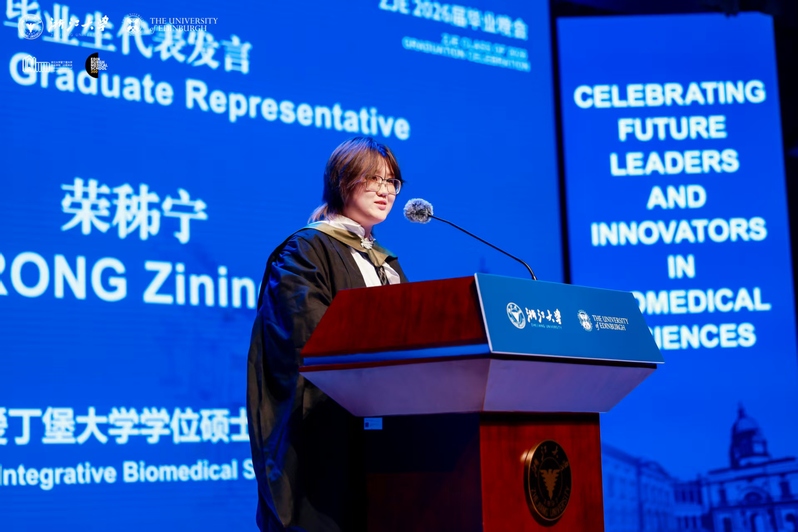
RONG Zining encapsulates the value of transnational education.
They are indeed a special group of graduates. For example, two of the class of 2026 acted as hosts for the event. I talked to one of the co-hosts, Ian Meliala, about why the graduation celebration was important to this cohort.
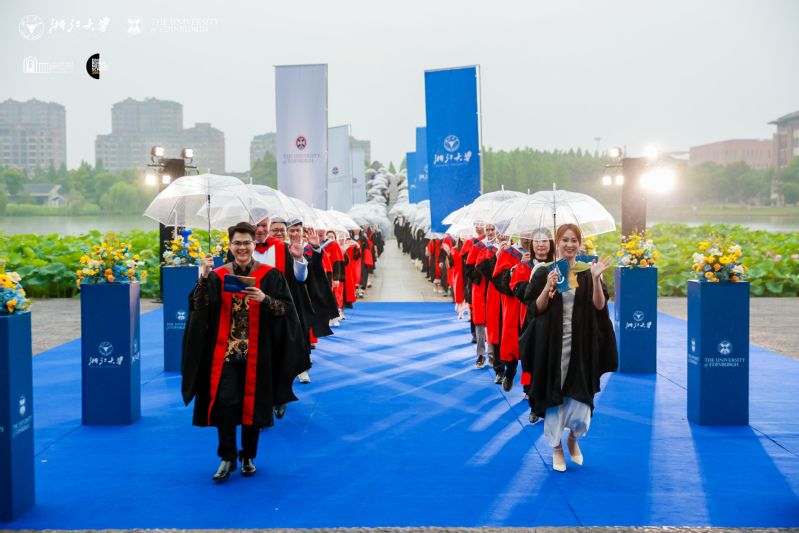
The rain didn’t stop the smiles from the happy graduates, led by Ian Meliala (l) and CHEN Yumo (r).
Ian said: For many international students, including me, graduation is not simply the end of a degree. It is the moment when years of navigating unfamiliar places, unfamiliar systems, and sometimes unfamiliar languages finally become visible.
I may have studied far from home, learned to express myself in a third or fourth language, and carried many quiet struggles that others never saw. To celebrate here, on the campus where those days actually unfolded, makes this achievement feel deeply real and shared.
Not every graduate will be able to attend the formal graduation ceremony in Edinburgh. Financial circumstances, timing, family responsibilities, distance, and life’s unexpected demands can make that difficult. That is why a celebration on our own campus matters: it is an inclusive reminder that every student deserves a moment to pause, be seen, and honour the journey they have completed.
To serve as the host is especially meaningful to me because I am also graduating far from my family. So, standing on the stage has become a quiet blessing. It allows me to do something I genuinely enjoy: to hold the space for everyone’s joy, to help the programme unfold smoothly, and to make sure that each graduate feels welcomed and celebrated. In helping to create this moment for others, I have also found a meaningful way to honour my own journey. Perhaps that is what community is: even when we arrive far from home, we can still become part of the hands that make others feel at home.
I think he is right: we are fostering a community and building relationships that will resonate into the future through our alumni association.
The second compere, CHEN Yumo, also took home the student prize for Overall Performance in the BSc Honours Biomedical Informatics. Showing her great versatility as both a scientist and a communicator.
Other prize winners were:
HUANG Yawen – Student Prize for Overall Performance in BSc Integrative Biomedical Sciences.
LIU Xiaofei – Student Prize for a Research Project on the BSc Honours Integrative Biomedical Sciences programme, for her research into reprogramming epithelial cells.
ZHAO Bingkang – Student Prize for a Research Project on the BSc Honours Biomedical Informatics programme, for his research into predicting yeast metabolomic profiles.
I was pleased to see three women scientists taking top spots in their class. We need more women moving to take top positions in science.
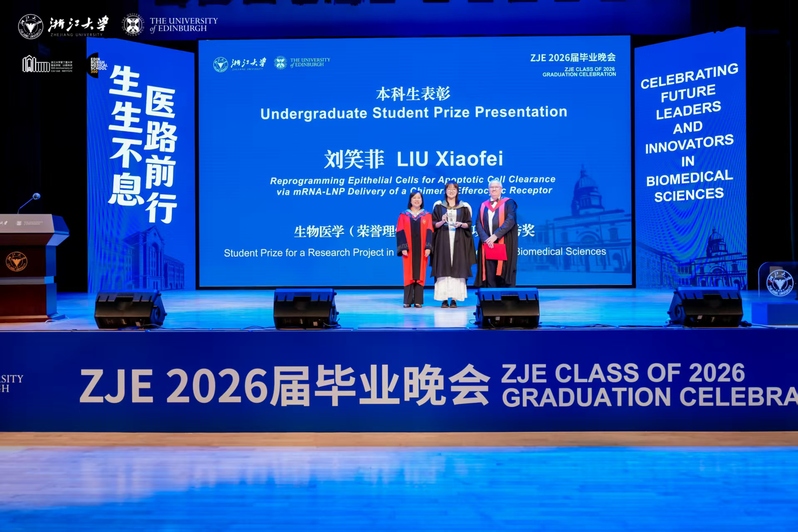
Future leader LIU Xiaofei accepting her award from Profs LI Min (L) and Mike Shipston (R)
There were other standout moments when the sense of community was most apparent. The opening procession saw our 134 undergraduates, 48 master’s graduates, 24 postdocs and around 30 faculty members enter the auditorium from the bridge across the campus lake. Bridges are great metaphors for graduation and the transformation of young people over time. Luckily, we had the foresight to provide umbrellas, but it would take more than a summer downpour to dampen the spirits of this procession. As they entered the hall, a piper provided traditional Scottish tunes, bringing a little bit of Edinburgh to Zhejiang.
The other standout moment was hearing 206 young people reaffirm their oaths, led by my colleagues John Menzies and CHEN Di. The heartfelt commitment of the graduates to serve science with integrity will stand them in good stead.
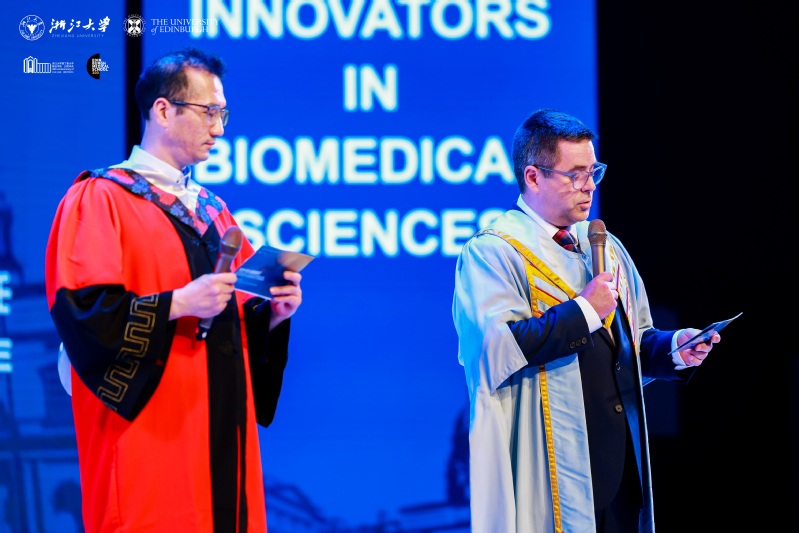
Prof CHEN Di (L) and Dr John Menzies (R) lead the students in ZJE affirmation.
I finished the evening by inviting the class of 2026 to turn around and face the gallery where the parents were seated. I thanked them for trusting their young people to ZJE. I then invited the graduates to thank their parents – some were in the room; others will see this on the video link later.
The combination of family support and the quality of the research-led education from ZJE have created an impressive cohort of young people. I speak for all my colleagues when I say we are immensely proud that we have unleashed these future leaders and innovators in the biomedical sciences. We will follow their progress with particular interest; it is them who will make this the golden age of biomedical science.
Blog written by Prof Sue Welburn, 19th June 2026