Huang Lab Publishes Collaborative ACS Nano Paper: Silk Fibroin Ion Conductors Enable High-Performance Wearable Perovskite LEDs
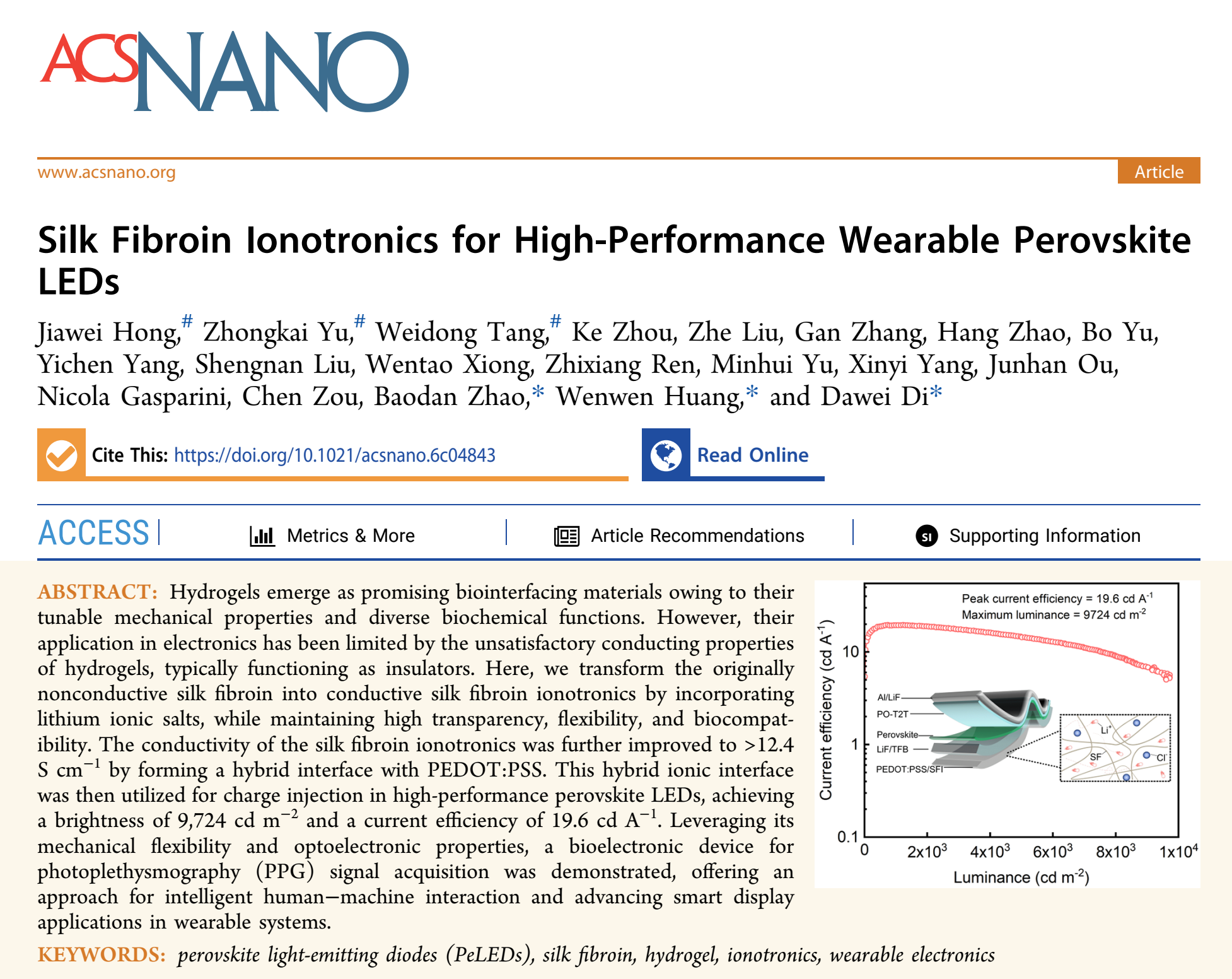
Silk fibroin (SF) is a naturally derived, biodegradable, and breathable material with excellent biocompatibility and processability, making it an ideal biomaterial for skin-friendly flexible electronic devices. However, natural silk fibroin is intrinsically nonconductive, which limits its direct use as a functional interface or charge-injection layer in electronic and optoelectronic devices. Endowing silk fibroin with efficient ion/electron transport capabilities while preserving its transparency, flexibility, and biocompatibility is therefore a key challenge for the development of next-generation wearable optoelectronic devices.Recently, the research team led by Researcher Wenwen Huang at the Zhejiang University-University of Edinburgh Institute (ZJE), in collaboration with the teams of Professor Dawei Di and Researcher Baodan Zhao from the College of Optical Science and Engineering and Haining International Joint Institute, Zhejiang University, published a research article in ACS Nano entitled “Silk Fibroin Ionotronics for High-Performance Wearable Perovskite LEDs.” The study proposes a strategy for converting naturally insulating silk fibroin into a high-performance silk fibroin ionotronic material (SFI). By introducing lithium salts into a silk fibroin system, the researchers constructed silk fibroin ionotronic films that combine high transparency, flexibility, biocompatibility, and ionic conductivity. These films were further integrated with PEDOT:PSS to form a mixed ion/electron-conducting interface, increasing the electrical conductivity to above 12.4 S cm⁻¹. Flexible perovskite light-emitting diodes (PeLEDs) based on this interface achieved a maximum luminance of 9,724 cd m⁻² and a current efficiency of 19.6 cd A⁻¹, and were successfully used for photoplethysmography (PPG) signal acquisition. This work provides a new materials and device platform for wearable displays, bioelectronics, and intelligent human-machine interaction.As shown in the figure below, the research team first used silk fibroin as a biofriendly flexible substrate and functional network, and constructed silk fibroin ionotronic materials by incorporating lithium chloride (LiCl). The introduction of lithium salts not only significantly increased the concentration of mobile ions in the system, but also enhanced the structural stability and mechanical properties of the material. Meanwhile, the SFI films retained excellent optical transparency: SF and SFI films with a thickness of 150 micrometers both exhibited transmittance above 90% in the visible-light range, higher than that of commonly used ITO transparent electrode substrates. This laid the foundation for their application in flexible transparent optoelectronic devices.In terms of interface design, the team combined SFI with PEDOT:PSS to construct a PEDOT:PSS/SFI hybrid conducting interface. The SFI substrate showed better wettability toward the PEDOT:PSS precursor solution, facilitating the formation of a uniform, low-defect conducting film. When the LiCl/SF mass ratio was 50%, the conductivity of the PEDOT:PSS/SFI film reached 12.49 S cm⁻¹, significantly higher than that of PEDOT:PSS/SF and PEDOT:PSS films directly deposited on PET substrates. Ultraviolet photoelectron spectroscopy and Kelvin probe force microscopy measurements showed that this interface had a higher work function and a more favorable surface-potential distribution, which helped improve hole injection and charge-transport efficiency.Based on this bio-ionotronic interface, the team fabricated ITO-free flexible perovskite LED devices with the structure PET/SFI/PEDOT:PSS/TFB/LiF/perovskite/PO-T2T/LiF/Al. Compared with PEDOT:PSS/SF control devices, PEDOT:PSS/SFI devices exhibited higher current density and luminance at the same voltage, ultimately achieving a maximum luminance of 9,724 cd m⁻² and a peak current efficiency of 19.56 cd A⁻¹, demonstrating excellent performance among ITO-free flexible LED systems.Further studies showed that the PEDOT:PSS/SFI interface could enhance the photoluminescence quantum efficiency of perovskite films and prolong the transient photoluminescence lifetime, indicating effective suppression of interfacial defect recombination. Space-charge-limited current measurements showed that devices based on PEDOT:PSS/SFI had a lower trap-filled limit voltage, lower trap-state density, and higher hole mobility. In addition, after 100 bending cycles at a bending radius of 10 mm, the devices retained approximately 80% of their initial luminance, indicating good flexibility and stability.The research team also demonstrated the potential of SFI-based flexible PeLEDs in wearable bioelectronics. By integrating the flexible PeLED with a silicon photodiode and a semiconductor analysis system, the team constructed a wearable optoelectronic sensing system for PPG signal acquisition. The green light emitted by the device can be effectively absorbed by blood, and the backscattered signal fluctuates periodically with changes in blood volume, enabling pulse-wave monitoring. The experimental results showed that the system could clearly capture PPG signals and further obtain acceleration plethysmogram (APG) features for the analysis of heart rate and parameters related to arterial elasticity.In terms of biocompatibility, the team evaluated SFI materials using human umbilical vein endothelial cells (HUVECs). Live/dead cell staining and CCK-8 assays showed that SFI had good cytocompatibility and supported cell proliferation. In addition, infrared thermal imaging showed that, during operation at a luminance of 1,000 cd m⁻², conventional ITO-based PeLEDs exhibited a temperature rise of up to 20.5 °C, whereas SFI-based devices showed a temperature rise of only about 1.7 °C. This suggests that SFI helps reduce local heat accumulation and improves safety and comfort in wearable applications.In summary, through ion doping and interface engineering, this study converted naturally insulating silk fibroin into a silk fibroin ionotronic material that combines high transparency, flexibility, biocompatibility, and high electrical conductivity. The hybrid conducting interface formed by this material and PEDOT:PSS effectively improved charge injection and transport in perovskite LEDs, enabling high-luminance, high-efficiency ITO-free flexible PeLED devices. The work further demonstrated a wearable bioelectronic system for PPG signal monitoring. This study not only offers a new approach for applying natural biomaterials such as silk fibroin in high-performance optoelectronic devices, but also opens new directions for the development of biofriendly ionotronic materials for wearable displays, health monitoring, and intelligent human-machine interaction.Jiawei Hong, a master’s student in Wenwen Huang’s team at the Zhejiang University-University of Edinburgh Institute; Zhongkai Yu, a specially appointed professor at the College of Physics and Optoelectronic Engineering, Yangtze University; and Weidong Tang, a postdoctoral researcher at the College of Optical Science and Engineering, Zhejiang University, are the co-first authors of the paper. The co-authors include Ke Zhou, Zhe Liu, and Gan Zhang, postdoctoral researchers at the College of Optical Science and Engineering, Zhejiang University; Hang Zhao and Junhan Ou, doctoral students in Wenwen Huang’s team at the Zhejiang University-University of Edinburgh Institute; Xinyi Yang, a master’s student; Bo Yu, an undergraduate student; Yichen Yang and Shengnan Liu, doctoral students at the College of Optical Science and Engineering, Zhejiang University; Wentao Xiong, a postdoctoral researcher; Zhixiang Ren, a doctoral student; Minhui Yu, a research assistant; Professor Nicola Gasparini of Imperial College London; and Chen Zou, a specially appointed researcher at the College of Optical Science and Engineering, Zhejiang University. Researcher Baodan Zhao of the College of Optical Science and Engineering, Zhejiang University; Researcher Wenwen Huang of the Zhejiang University-University of Edinburgh Institute; and tenured Professor Dawei Di of the College of Optical Science and Engineering, Zhejiang University, are the co-corresponding authors. This work was supported by the National Natural Science Foundation of China, the Zhejiang Provincial Natural Science Foundation of China, and other funding sources.Original article: https://doi.org/10.1021/acsnano.6c048431.Research Group ProfileResearcher at Zhejiang University; doctoral supervisor; Zhejiang Province high-level talent; adjunct professor at the Second Affiliated Hospital of Zhejiang University School of Medicine; Honorary PI at the University of Edinburgh. Professor Huang has led multiple projects funded by the National Natural Science Foundation of China and provincial/ministerial programs. Her research has long focused on protein-based materials, including the rational design of recombinant proteins, protein-material processing, regenerative medicine, and combined tumor therapies. She has published more than 50 related international papers, with an H-index of 31. She has been invited to serve as regional chair and publication chair for the International Conference on Biomedical Engineering and Applications, and as a reviewer for more than 30 academic journals. She is also a fixed member of the State Key Laboratory of Automotive Biofuels Technology and the Li Dak Sum & Yip Yio Chin Center for Stem Cell and Regenerative Medicine.The group applies engineering technologies to address the emerging shift from a disease-treatment-centered model to a health-centered model. It has established a recombinant-protein innovation platform guided by protein function, based on biosynthesis and simulation prediction, and validated and optimized through high-throughput preparation, analysis, and functional testing. The group conducts systematic research on the design and clinical translation of new biomaterials.Group website: https://wenwenhuang.com/Contact email: wenwenhuang@intl.zju.edu.cnThe group is recruiting highly self-motivated postdoctoral fellows, doctoral students, and master’s students, including applicants for the University of Edinburgh’s single PhD and single master’s programs through the application-based route. Further information: https://biomedical-sciences.ed.ac.uk/connections-outreach/international-activities/zje-institute
2026-06-04